
Nespresso Lifestyle™
On coffee, beans, new music and choosing the slower path.

Hello folks, this week I am returning to an earlier format that I introduced here, and expanded on here. The concept is simple: an introductory musing, a recipe, and an album to go with it. The recipe is loose—more art than science, with no exact times or measurements. The album, curated by me or maybe by a guest one day, will reflect the mood, spirit, or ethos of the dish.
The Musing – Nespresso Lifestyle
I recently had a friend suggest that his Nespresso machine was an acceptable option for his daily coffee.
See, my friend here is a good person, an honest man, who appreciates quality food and drink well enough. Which is why he was so shocked at my response.
“It’s not personal,” I told him, “and while it is an entirely unacceptable take, I don’t think less of you for it.”
But, the truth is, I kind of do.
It’s not his fault, however. Culturally we have slipped into what I’ve dubbed the “Nespresso Lifestyle”™: trading quality and enjoyment for ease and convenience at almost every turn. Maybe it’s the natural end state of capitalism—the logical conclusion of businesses charging us (and us being willing to pay) more and more for every second of time returned. More time to scroll. More time to “work” (i.e., respond to meaningless Slack messages).
What we’re really lacking, however, is context. We’ve lost sight of the old ways, the rituals that came before we “made Big Money,” as M.F.K. Fisher once put it.
“Have you ever made a pour-over coffee?” I asked my friend, at risk of sounding pretentious.
It takes about ten minutes to weigh, grind, measure, and pour. But the second it hits your lips, you’ll know it was worth it. Besides, it costs less, fills your home with one of the most lovely smells, and, most of all, it’s a pleasant act.
Making pour-over coffee, like cooking dinner instead of ordering Uber Eats (don’t even get me started), is meditative. It leaves you with a peace no scroll or Slack emoji reaction from your manager could.
The Recipe – Beans
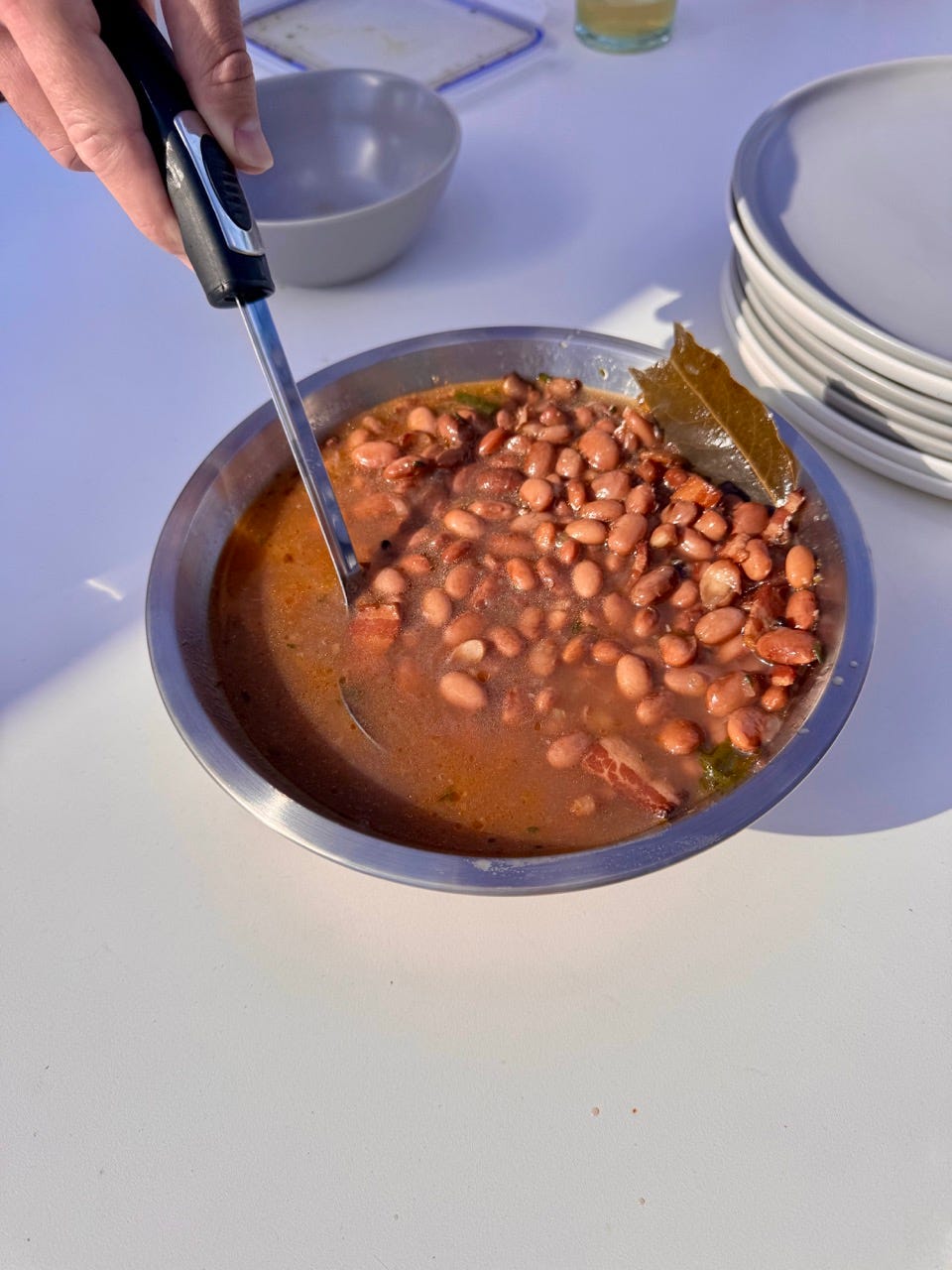
Speaking of things worth doing the slow way, I’ve been meaning to write out this recipe for a while. This morning I was reading a take from Jonah of Blackbird Spyplane about how he mistrusts anything that feels completely atheistic. I agree. We’re in a time of lost morality, and we need faith. Even if it’s not faith in a higher power per se, we need something to root us back to a moral compass. Let me suggest beans.
I grew up on beans, they were the lifeblood of our family, as they have been for many families over many generations. They were also the most requested dish when the homies came over. There are several meals that can be derived from a single pot of beans, and they make for one of the most economical meals one can produce. The beautiful thing about beans is that they don’t require anything other than dried beans, a big pot, and time to cook them well. Beans remind me, as I am often needing to be reminded, that some of my best eating is not done in the most expensive or elaborate of settings. Oftentimes it’s done in the places, or the moments, that are most simple and familiar.
For years, though, I took the “Nespresso Lifestyle” route and only cooked canned beans. For ease, of course, but also for fear of messing up the sacred bean. But beans are forgiving, and you know what they say: the best things in life lie on the other side of fear.
My mom cooks hers in a pressure cooker, which certainly speeds things up. But if you, like me, live in a small New York apartment without cabinet space—or if you, like me, are pushing yourself to slow things down—you can cook them just fine in a standard pot.
Beans are versatile. Experiment. Today, however, I’ll share my go-to Brazilian-leaning recipe, which I like to make with black or pinto beans and that, with a side of rice, can make for a complete meal.
Ingredients
1 lb dry beans (black or pinto)
~3 cloves garlic
~1 medium onion
1–2 celery stalks
1 medium carrot
½-1 lb bacon
Whole black peppercorns (to taste)
Salt (to taste)
1–2 bay leaves
Water (or stock of choice)
Method
Soak beans for 2-12 hours (depending on the quality of beans you buy). I do this by adding beans to a clean bowl, and covering with fresh water (about 2 inches above the beans).
Cook bacon in a large, high-rimmed pot. Remove and set aside.
In the bacon fat, cook chopped onion, garlic, celery, and carrot until fragrant and soft (~5 min).
Add soaked beans and stir into the aromatics.
Cover beans with stock or water (I like the liquid ~4 inches above the beans for a brothy end result).
Add black peppercorns and bay leaf. Bring to a boil, then reduce to a simmer.
Add bacon back in, cover, and simmer for ~2–3 hours.
Salt generously but only once beans are soft (about halfway through), tasting often.
The beans are “done” when they have swelled and their skins burst when blown upon.
Should you have further curiosities about the cooking of beans, I would point you to the ‘How to Live Well’ chapter of Tamar Adler’s gorgeous book An Everlasting Meal, which greatly inspired this section.
The Album – Tuff Times Never Last, Kokoroko
I’ve been a big fan of Kokoroko since their 2022 debut Could We Be More. Their sound always came across as something unique: an elegant fusion of jazz, Afrobeats, and highlife, which carries the warmth of West African traditions while layering in the textures of funk, neo-soul, and UK R&B.
Their follow-up, Tuff Times Never Last, which I’ll focus on here, dropped earlier this summer. The release timing was perfect for me, as I opened up my Apple Music app in a world of pain after a bender of a weekend at the Calgary Stampede with the lads. Let’s just say, I needed to be reassured on that early flight home that tough times, indeed, never last.
Joking aside, across eleven tracks, bandleaders Onome Edgeworth and Sheila Maurice-Grey guide the ensemble through variations on a single theme: togetherness. Sometimes this tape leans romantic, as on “Just Can’t Wait,” which shimmers with the anticipation of a late-night rendezvous. Sometimes it feels communal, as on “Closer to Me” or the feather-light “Sweetie,” which play at different intensities. Always, though, it’s music designed to gather and unite people.
That spirit feels especially urgent now. Reading Sam Harris’s brilliant piece We Are Losing the Information War with Ourselves over the weekend, I was struck by the way he reinforced that social platforms have become an accelerant for our worst instincts: widening tribal hatreds, convincing us that niche viral takes represent the whole, and leaving us poisoned by noise. Tru*p, Harris writes, is “an arsonist pretending to be a firefighter”—a perfect metaphor, in my opinion, for what the platforms themselves have become. The antidote is not more scrolling. It’s choosing, in the theme of this newsletter, slowness: finding friends, having hard conversations, cooking our food.
Kokoroko’s tape embodies that choice, which is why I wanted to highlight it today. Like beans simmering slowly alongside the above ingredients in a pot, its many elements—horns, bass, percussion, voices—meld into something greater than the sum of their parts.
When the album begins with the lyric, “You are never lost when you’re with me,” I’m reminded that we are never lost but only if we’re willing to embrace each other
Vem fazer este feijão na minha casa🌿
I will have a feijoada ready for you in Rio❤️